Introduction
Choosing an interpreting career can be an exciting decision, but it also requires careful consideration of the type of work environment, responsibilities, and skills that best fit your personality and professional goals. Two important career paths are medical interpreting and court interpreting.
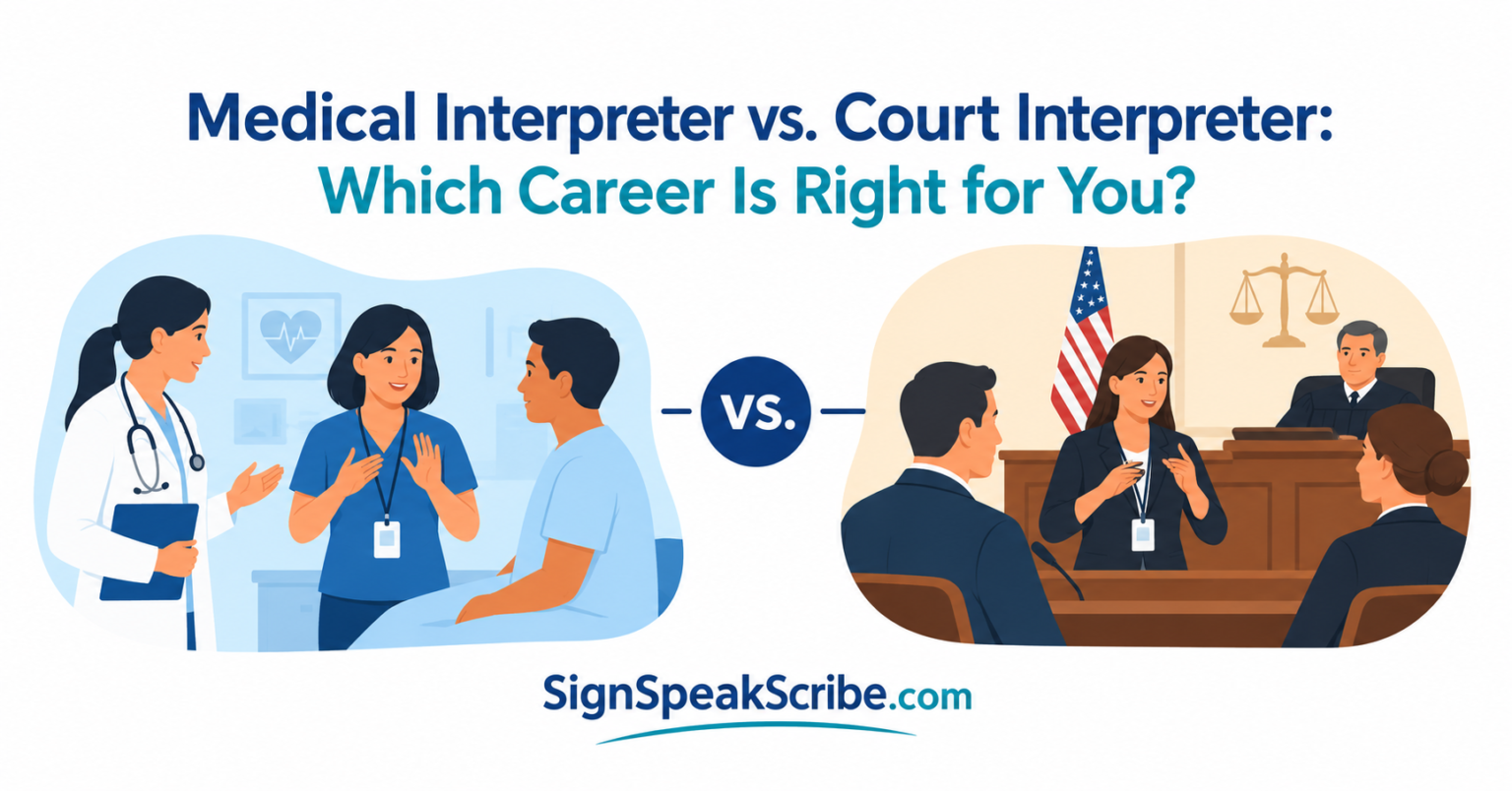
Although both professions help people communicate across language barriers, the settings are very different. A medical interpreter may work in hospitals, clinics, physician offices, or other healthcare environments, while a court interpreter works in legal proceedings where accuracy can have significant consequences.
So, when comparing a medical interpreter vs. court interpreter, which career is right for you?
The answer depends on your interests, temperament, language skills, ability to handle stressful situations, and the type of professional environment you prefer.
Let’s take a closer look at both career paths.
1. What Does a Medical Interpreter Do?
A medical interpreter helps patients, healthcare providers, and other members of a healthcare team communicate when they do not share the same language.
Medical interpreters may work in hospitals, outpatient clinics, emergency departments, mental health settings, specialty practices, or through remote interpreting services.
Their responsibilities can include interpreting conversations between patients and healthcare professionals, assisting with medical histories, explaining procedures through interpretation, and supporting communication during appointments.
Medical interpreting requires more than simply knowing two languages. Interpreters need a strong understanding of medical terminology and the ability to accurately convey information while maintaining professional boundaries and confidentiality.
What Makes Medical Interpreting Unique?
Healthcare situations can be highly personal and emotionally difficult. An interpreter may be present during a serious diagnosis, surgery consultation, emergency situation, or end-of-life discussion.
Because of this, medical interpreters need to remain professional while also being sensitive to the emotional circumstances surrounding the interaction.
For someone who enjoys helping people directly and wants to contribute to better communication in healthcare, a medical interpreter career can be highly rewarding.
2. What Does a Court Interpreter Do?
A court interpreter provides language interpretation during legal proceedings and other situations involving the justice system.
Court interpreters may work in courtrooms, depositions, attorney-client meetings, administrative hearings, or other legal settings, depending on their qualifications and the jurisdiction in which they work.
The interpreter’s role is to accurately convey what is being said without changing, adding, or omitting information.
Court interpreting can involve highly technical legal terminology, rapid dialogue, questioning by attorneys, testimony from witnesses, and emotionally charged situations.
What Makes Court Interpreting Unique?
Legal proceedings demand an extremely high level of accuracy. A mistranslated or incorrectly interpreted statement could potentially affect someone’s legal rights, case, or understanding of the proceedings.
Court interpreters therefore need excellent concentration, strong language proficiency, knowledge of legal terminology, and the ability to remain neutral under pressure.
For someone who enjoys structured environments, legal terminology, and working within the justice system, a court interpreter career may be a strong fit.
3. Medical Interpreter vs. Court Interpreter: Key Differences
While both careers require exceptional language skills and professionalism, the day-to-day experience can be quite different.
| Medical Interpreter | Court Interpreter | |
|---|---|---|
| Primary Setting | Hospitals, clinics, healthcare facilities | Courts, hearings, legal proceedings |
| Primary Focus | Healthcare communication | Legal communication |
| Terminology | Medical terminology | Legal terminology |
| Work Environment | Healthcare teams and patient interactions | Judges, attorneys, witnesses, defendants, and other legal professionals |
| Emotional Environment | Can involve illness, injury, and difficult diagnoses | Can involve criminal, family, immigration, and civil matters |
| Key Skills | Medical vocabulary, empathy, accuracy | Legal vocabulary, concentration, neutrality |
| Typical Pressure | Emergencies and sensitive healthcare situations | Legal proceedings and high-stakes testimony |
Neither career is necessarily “better.” They simply require different interests, strengths, and professional preferences.
4. Skills You’ll Need for Either Career
Regardless of whether you choose medical interpreting or court interpreting, several fundamental skills are essential.
Exceptional Language Proficiency
Interpreters must have strong command of both the source and target languages. Understanding vocabulary, grammar, cultural references, idioms, and different communication styles is essential.
Accuracy
Interpreters must communicate the speaker’s message accurately without intentionally changing its meaning.
Active Listening
Interpreters need to listen carefully, process information quickly, and produce an accurate interpretation—often with very little time between hearing and interpreting the message.
Professionalism
Confidentiality, ethical conduct, appropriate boundaries, and professional behavior are essential in both fields.
Cultural Competence
Language and culture are closely connected. Understanding cultural differences can help interpreters recognize potential communication barriers and facilitate clearer interactions.
5. Which Career Is More Stressful?
Both careers can be stressful, but the source of that stress may differ.
Medical interpreters may encounter emergencies, serious medical conditions, emotional conversations, and unpredictable situations. They may also need to interpret complex medical information quickly.
Court interpreters can face pressure from formal legal proceedings, fast-paced questioning, difficult terminology, and situations where accuracy is particularly critical.
Your personality may influence which type of pressure you prefer.
If you are comfortable working with patients and healthcare professionals and find purpose in helping people navigate healthcare, medical interpreting may be a good choice.
If you prefer structured proceedings, legal terminology, and a courtroom environment, court interpreting may be more appealing.
6. Consider Your Professional Interests
One of the best ways to choose between these careers is to consider what subjects genuinely interest you.
Choose medical interpreting if you:
- Are interested in healthcare and medicine
- Enjoy working directly with patients
- Are comfortable in hospitals and clinical environments
- Can remain composed during emotional situations
- Want to help improve communication between patients and healthcare providers
Consider court interpreting if you:
- Are interested in law and the justice system
- Enjoy legal terminology and formal proceedings
- Have excellent concentration
- Are comfortable working in high-pressure environments
- Can maintain neutrality during emotionally difficult proceedings
Your interests matter because specialization often requires ongoing education and professional development.
Key Takeaways
- Medical interpreters primarily facilitate communication in healthcare environments.
- Court interpreters primarily facilitate communication in legal settings.
- Both careers require excellent language proficiency, accuracy, listening skills, and professionalism.
- Medical interpreting may be a good fit for people interested in healthcare and direct patient interaction.
- Court interpreting may appeal to people interested in law, legal proceedings, and structured professional environments.
- Both professions can involve emotionally difficult and high-pressure situations.
- The best career choice depends on your interests, strengths, personality, and professional goals.
FAQ
Is medical interpreting easier than court interpreting?
Neither profession should be considered inherently easier. Both require specialized knowledge, strong interpreting skills, accuracy, and professional judgment. The difficulty often depends on the setting, language pair, specialization, and individual interpreter.
Do medical interpreters need to know medical terminology?
Yes. A strong understanding of medical terminology is an important part of providing accurate interpretation in healthcare settings.
Do court interpreters need to know legal terminology?
Yes. Court interpreters need strong knowledge of legal terminology and the language used in legal proceedings.
Can an interpreter work in both medical and legal settings?
It may be possible, depending on an interpreter’s qualifications, training, certifications, language pair, and applicable requirements. However, interpreters should develop the specialized knowledge necessary for each setting rather than assuming general language proficiency is sufficient.
Which interpreting career pays more?
Compensation can vary considerably depending on location, language pair, qualifications, experience, employment arrangement, and demand. Rather than choosing a specialty based solely on potential income, consider the work environment and type of interpreting that best matches your long-term goals.
Conclusion
When comparing medical interpreter vs. court interpreter, there is no universal winner. Both are important language access professions, but they serve very different purposes.
Medical interpreters help patients and healthcare professionals communicate during some of life’s most important and vulnerable moments. Court interpreters help ensure that language barriers do not prevent people from participating meaningfully in legal proceedings.
The right career for you ultimately comes down to your interests and strengths.
If healthcare, patient communication, and medical terminology appeal to you, medical interpreting may be the right path. If you are drawn to law, courtroom environments, and legal terminology, court interpreting may be a better fit.
Whichever path you choose, professional preparation, specialized knowledge, ethical practice, and continuous learning can help you build a successful career as a language access professional.
Call to Action
Ready to explore your next opportunity? Visit SignSpeakScribe.com to discover job opportunities and career resources designed specifically for language access professionals.