Introduction
The language access industry has changed significantly over the years.
What was once a collection of relatively specialized markets—sign language interpreting, spoken language interpreting, captioning, translation, and other services—has increasingly become a connected and expanding industry. Interpreter agencies and language service providers have broadened their offerings, employers have developed more complex language-access needs, and professionals have gained opportunities to work across an increasingly diverse marketplace.
This evolution has also changed the way language-access professionals find work.
Historically, a professional might rely heavily on an agency, professional network, word of mouth, or industry association to find assignments and employment opportunities. Today, employers and professionals have access to digital platforms that can connect them more directly.
This changing landscape is one of the reasons SignSpeakScribe.com was created.
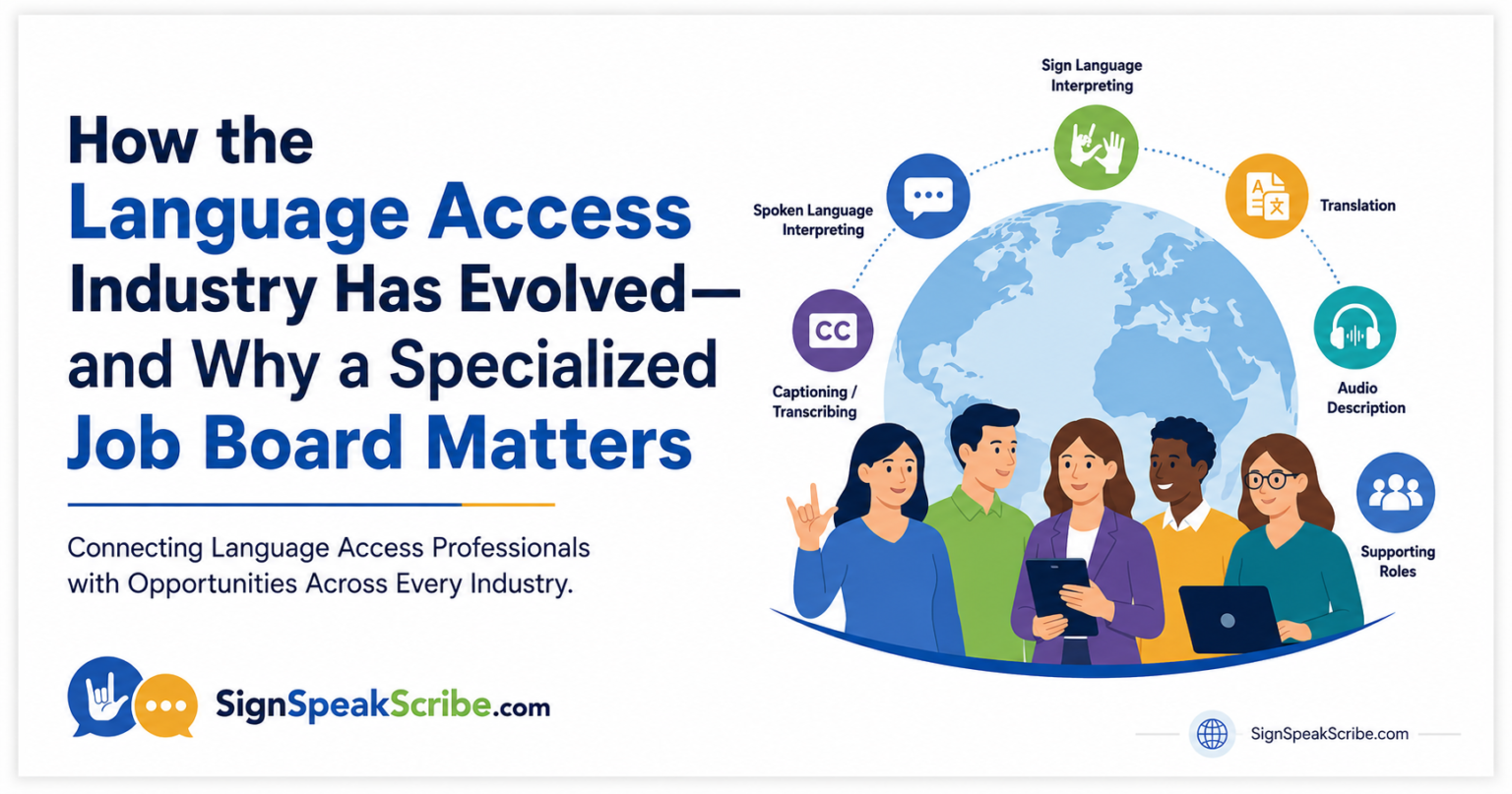
SignSpeakScribe is a job board specifically focused on the broader language access industry, bringing together opportunities for sign language interpreters, spoken language interpreters, captioners and transcriptionists, translators, audio description professionals, and other supporting roles.
The goal is simple: make it easier for language-access professionals and employers to find each other.
The Traditional Language Access Agency Model
For many years, language-access services were often organized around specialized agencies and service providers.
A sign language interpreting agency, for example, might develop a network of freelance sign language interpreters. When a hospital, school, business, government agency, or other organization needed an interpreter, the agency would coordinate the assignment and refer an interpreter to the client.
The basic model looked something like this:
Client → Agency → Freelance Interpreter
A similar model existed in spoken language interpreting.
Spoken language interpreter agencies developed networks of interpreters covering languages such as Spanish, Hmong, Mandarin, Arabic, Vietnamese, and many others. When an organization needed an interpreter, the agency coordinated the request and assigned an available professional.
This model provided an important service to employers because they did not necessarily have to maintain their own networks of independent language-access professionals.
The agency became the intermediary connecting the client with the professional.
When Language Access Markets Began to Overlap
The traditional separation between language-access services did not remain permanent.
As demand changed and competition increased, some agencies began expanding beyond their original specialties.
A spoken language interpreting agency might recognize an opportunity to provide sign language interpreting. A sign language interpreting agency might begin offering spoken language interpreting. Other providers could add captioning, translation, transcription, or additional language-access services.
From a business perspective, this expansion can be understood as competition and diversification.
If a client needs several types of language-access services, there can be an obvious advantage to working with one provider capable of handling multiple needs.
For example, an organization might need:
- Sign language interpreting
- Spoken language interpreting
- Captioning / Transcribing
- Translation
- Audio description
Instead of working with several specialized providers, the organization may prefer a company that can coordinate multiple services.
This changed the competitive landscape.
The lines that once separated different areas of language access became increasingly difficult to define.
Competition Changed the Industry
Competition is a normal part of business.
When one company enters a market that was historically served by specialized providers, existing businesses have several choices. They can maintain their specialization, differentiate themselves through expertise, expand their services, or compete on other factors such as pricing, availability, technology, geographic coverage, or customer service.
Language access was no different.
As agencies expanded into additional service categories, other agencies had incentives to expand as well.
Over time, an agency that once specialized in one area could become a broader language service provider.
This created a more interconnected industry.
The important point is not whether this development was necessarily good or bad. Rather, it changed the structure of the marketplace.
The industry evolved.
And when an industry evolves, the way professionals find work and the way employers find professionals must evolve with it.
The Rise of the Multi-Service Language Access Provider
Today, it is increasingly common for language service providers to offer multiple types of services.
A company may provide interpreting, translation, captioning, and other language-access solutions under the same organization.
This creates advantages for employers.
A hospital system, university, government agency, corporation, or other large organization may have language-access needs that vary significantly from one situation to another.
One department may need a spoken language interpreter.
Another may need a sign language interpreter.
Another may need captioning.
Another may need translated materials.
Another may need audio description.
The employer’s need is not necessarily organized around the professional’s historical industry category.
The employer’s need is simply:
“We need language access.”
That distinction is important.
What This Means for Language Access Professionals
The expansion of language-access services also affects professionals.
Interpreters, translators, captioners, transcriptionists, audio descriptionists, and other specialists may encounter opportunities from organizations that did not traditionally operate within their particular professional niche.
At the same time, professionals may face a more competitive marketplace.
More providers can mean more opportunities—but it can also mean more competition for those opportunities.
This makes visibility increasingly important.
A highly qualified professional can still miss opportunities if employers cannot easily find the job posting, understand the position, or connect with the organization offering the opportunity.
That is where specialized employment platforms can play an important role.
Why Not Just Create a Sign Language Job Board?
This question is central to the development of SignSpeakScribe.
A specialized sign language interpreter job board would certainly have made sense.
Sign language interpreting is a distinct profession with its own professional organizations, educational pathways, certification systems, employers, and workforce.
However, the broader industry was changing.
If agencies and employers were increasingly expanding across language-access categories, limiting a job board exclusively to sign language interpreting would create an artificial boundary.
The market had already begun moving beyond that boundary.
Instead of asking:
“What kind of agency is this?”
it became more useful to ask:
“What kind of language-access professional does this employer need?”
That shift in perspective helped shape the concept behind SignSpeakScribe.
Why SignSpeakScribe Covers Multiple Language Access Professions
SignSpeakScribe was created as a specialized job board for the broader language access industry.
The platform brings together employment opportunities across multiple professional categories, including:
Sign Language Interpreting
Opportunities for sign language interpreters working in healthcare, education, government, business, community settings, remote environments, and other areas.
Spoken Language Interpreting
Opportunities for spoken language interpreters serving individuals and organizations across healthcare, legal, government, business, education, and other industries.
Captioning and Transcribing
Opportunities for captioners, CART professionals, transcriptionists, and related specialists who provide accessibility and communication services.
Translation
Opportunities for translators working with written language, documents, digital content, organizations, and specialized industries.
Audio Description
Opportunities for professionals who make visual content more accessible through audio description and related accessibility services.
Supporting Roles
The language access industry also requires professionals who support the delivery, administration, coordination, technology, operations, and management of these services.
Together, these professions form a broader ecosystem.
SignSpeakScribe Is a Job Board—Not an Interpreter Agency
There is an important distinction between SignSpeakScribe and a traditional interpreter agency or language service provider.
An agency typically focuses on providing the service.
It may receive a request from a client, locate an available professional, coordinate the assignment, and manage the relationship between the client and the professional.
A job board serves a different function.
A job board focuses on connecting employers and job seekers.
The basic relationship becomes:
Employer → Job Board → Professional
SignSpeakScribe is designed to help employers reach language-access professionals while giving professionals a centralized place to discover employment opportunities.
This distinction allows SignSpeakScribe to support the broader industry without attempting to replace the specialized work performed by agencies.
Why a Niche Job Board Still Matters
Some people might ask:
“Why do we need a specialized language access job board when there are already large job boards?”
Large employment platforms serve millions of jobs across virtually every industry.
That scale is useful—but it can also make specialized professions difficult to discover.
A language-access professional searching for work may have to sort through thousands of unrelated listings.
Employers face the opposite problem.
An organization looking for a specialized language-access professional may struggle to reach the right audience on a general employment platform.
A niche job board solves part of that problem by creating a concentrated marketplace.
Instead of searching through the entire employment market, professionals can look specifically for language-access opportunities.
Instead of advertising to everyone, employers can advertise directly to an audience interested in language access.
A More Connected Language Access Workforce
The future of language access is unlikely to look exactly like its past.
Technology has already changed how services are delivered.
Remote interpreting, video interpreting, remote captioning, digital translation tools, accessibility technology, and other innovations have made geographic boundaries less significant.
At the same time, organizations increasingly recognize that language access and communication accessibility are important across healthcare, education, government, business, entertainment, technology, and other industries.
The result is a broader and more interconnected professional ecosystem.
The traditional categories still matter because each profession has its own specialized skills and standards.
But they can also exist within a larger language-access marketplace.
That is the space SignSpeakScribe is designed to serve.
The Future of Language Access Employment
The evolution of the language-access industry raises an important question:
How will professionals and employers connect in the future?
The traditional agency model will continue to play an important role.
Agencies provide valuable services, manage client relationships, coordinate assignments, and help organizations meet complex language-access needs.
But agencies are not the only way employers and professionals can connect.
Job boards, professional networks, online communities, company career pages, and other digital platforms are creating additional pathways.
That can give professionals more ways to discover opportunities and give employers more ways to reach specialized talent.
The employment marketplace does not have to be either agencies or job boards.
There is room for both.
SignSpeakScribe’s Role in the Industry
SignSpeakScribe exists because the language-access industry has evolved.
What began as relatively distinct professional and agency markets has become a much broader ecosystem.
As agencies expanded their services, the boundaries between sign language interpreting, spoken language interpreting, captioning, translation, audio description, and related services became increasingly interconnected.
SignSpeakScribe reflects that reality.
Rather than limiting the platform to one profession, SignSpeakScribe brings together employment opportunities across the broader language-access field.
The mission is not to replace agencies.
It is not to decide who is qualified to work in the profession.
And it is not to tell employers which professionals they should hire.
Instead, SignSpeakScribe provides a dedicated place where language-access employers and professionals can find each other.
Key Takeaways
- The language-access industry has evolved from relatively specialized markets into a more interconnected ecosystem.
- Interpreter agencies and language service providers have increasingly expanded their service offerings.
- Competition and client demand have contributed to the expansion of services.
- Sign language, spoken language, captioning, transcription, translation, and audio description increasingly exist within the same broader language-access marketplace.
- This evolution creates both opportunities and competition for professionals.
- General job boards can make specialized language-access positions difficult to find.
- A niche job board can provide a more focused connection between employers and language-access professionals.
- SignSpeakScribe was created to serve the broader language-access employment market rather than limiting itself to one professional category.
Conclusion
The language-access industry has never been static.
Professional roles evolve. Agencies expand. Technology changes how services are delivered. Employers develop new accessibility and communication needs. Professionals discover new ways to build their careers.
As the industry has expanded, the traditional boundaries separating different language-access services have become less rigid.
That evolution is the foundation for SignSpeakScribe.
SignSpeakScribe.com is the job board for language access professionals, bringing together employment opportunities across sign language interpreting, spoken language interpreting, captioning and transcribing, translation, audio description, and supporting roles.
The industry has become broader.
The employment marketplace should reflect that reality.
Whether you’re an employer looking for language-access talent or a professional looking for your next opportunity, SignSpeakScribe is built to help connect the two.
Explore language-access jobs at SignSpeakScribe.com.