Introduction
Human Expertise vs AI has become one of the biggest conversations in today’s workforce. Artificial intelligence has transformed countless industries, including healthcare, customer service, education, legal services, and language access. AI-powered translation tools, speech recognition, automated captioning, and conversational assistants are becoming faster and more accessible every year.
While these technologies offer valuable support, they have not replaced the need for skilled language access professionals. Communication is more than converting words from one language to another—it requires understanding culture, emotion, intent, ethics, confidentiality, and context.
As organizations continue adopting AI, the demand for qualified interpreters, translators, captioners, transcriptionists, audio description specialists, and other language access professionals remains strong. Rather than replacing professionals, AI is becoming another tool that supports their work.
AI Is Improving Language Access—But It Has Limits
Artificial intelligence has made impressive progress in several areas, including:
- Real-time speech recognition
- Machine translation
- Automatic caption generation
- Voice synthesis
- Multilingual chatbots
These tools improve efficiency and reduce turnaround time for simple communication tasks.
However, AI still struggles with situations involving:
- Regional dialects
- Cultural expressions
- Humor and sarcasm
- Medical terminology
- Legal language
- Emotional conversations
- Ambiguous wording
- Multiple speakers talking simultaneously
Even a small misunderstanding can have serious consequences in healthcare, legal proceedings, education, or emergency response.
Human Professionals Understand Context
One of the greatest strengths of human professionals is understanding context.
Professional interpreters and translators do far more than translate vocabulary. They evaluate:
- Tone of voice
- Facial expressions
- Body language
- Cultural expectations
- Speaker intent
- Industry-specific terminology
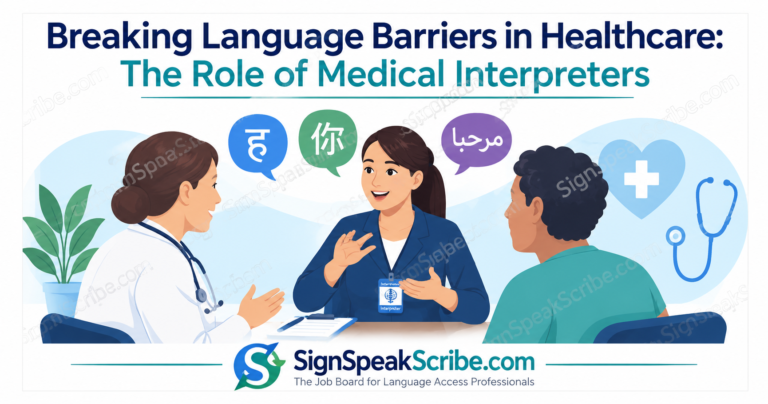
For example, during a medical appointment, an interpreter may recognize when a patient’s hesitation or confusion requires clarification. AI may simply translate the words without recognizing the underlying concern.
In legal proceedings, precision matters. A single inaccurate translation can alter testimony or affect someone’s legal rights.
Human expertise ensures communication remains accurate, complete, and meaningful.
Cultural Competence Cannot Be Automated
Language and culture are deeply connected.
Experienced language access professionals understand:
- Cultural etiquette
- Appropriate terminology
- Regional language differences
- Community preferences
- Sensitive topics
- Historical context
A direct word-for-word translation often sounds unnatural—or even offensive—in another language.
Professional translators know when to adapt wording while preserving the original meaning.
This cultural awareness is something AI continues to struggle with because it relies primarily on statistical patterns rather than lived human experience.
Trust Matters During Sensitive Conversations
Many language access situations involve highly personal information, including:
- Medical diagnoses
- Mental health counseling
- Legal consultations
- Child protection cases
- Immigration interviews
- Employment investigations
People often need reassurance that they are truly being understood.
Human interpreters build trust through professionalism, empathy, confidentiality, and ethical decision-making.
Even the most advanced AI cannot provide emotional intelligence during difficult conversations.
Accessibility Requires More Than Automation
Language access extends beyond spoken languages.
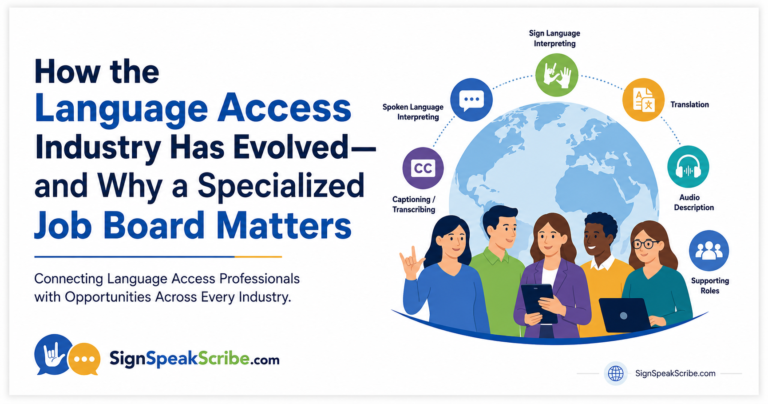
Professionals also provide services such as:
- Sign language interpreting
- CART captioning
- Closed captioning
- Transcription
- Audio description
- Localization
- Document translation
Each specialty requires technical expertise that goes well beyond automated software.
For example:
Audio description professionals carefully decide which visual details are most meaningful to describe during pauses in dialogue.
Captioners consider readability, timing, speaker identification, sound effects, and accessibility standards—not simply converting speech into text.
These decisions require human judgment.
AI Works Best as a Tool—Not a Replacement
Many language access professionals are already using AI to improve productivity.
Examples include:
- Drafting initial translations
- Speech-to-text assistance
- Terminology research
- Workflow automation
- Quality assurance checks
- Project organization
Instead of replacing professionals, AI often reduces repetitive tasks so experts can focus on quality, accuracy, and client communication.
This partnership creates better outcomes than relying entirely on automation.
Professional Ethics Still Require Human Judgment
Language access professionals follow established ethical standards, including:
- Confidentiality
- Accuracy
- Impartiality
- Professional conduct
- Cultural sensitivity
When unexpected situations arise, professionals make informed decisions based on ethics and experience.
AI cannot independently exercise ethical judgment or understand the broader consequences of a communication error.
This is particularly important in healthcare, courts, government agencies, and educational settings where people’s rights and well-being are involved.
Employers Continue to Value Skilled Professionals
Organizations increasingly recognize that AI is only one part of an effective language access strategy.
Many employers seek professionals who can:
- Work alongside AI technologies
- Review machine-generated content
- Ensure accuracy
- Protect confidentiality
- Communicate effectively with diverse populations
- Handle complex conversations
Professionals who embrace technology while maintaining strong human communication skills will continue to be highly valuable in the years ahead.
The Future Is Human Plus AI
The future of language access is not a competition between humans and artificial intelligence.
Instead, it is a collaboration.
AI will continue improving speed, efficiency, and workflow automation.
Human professionals will continue providing:
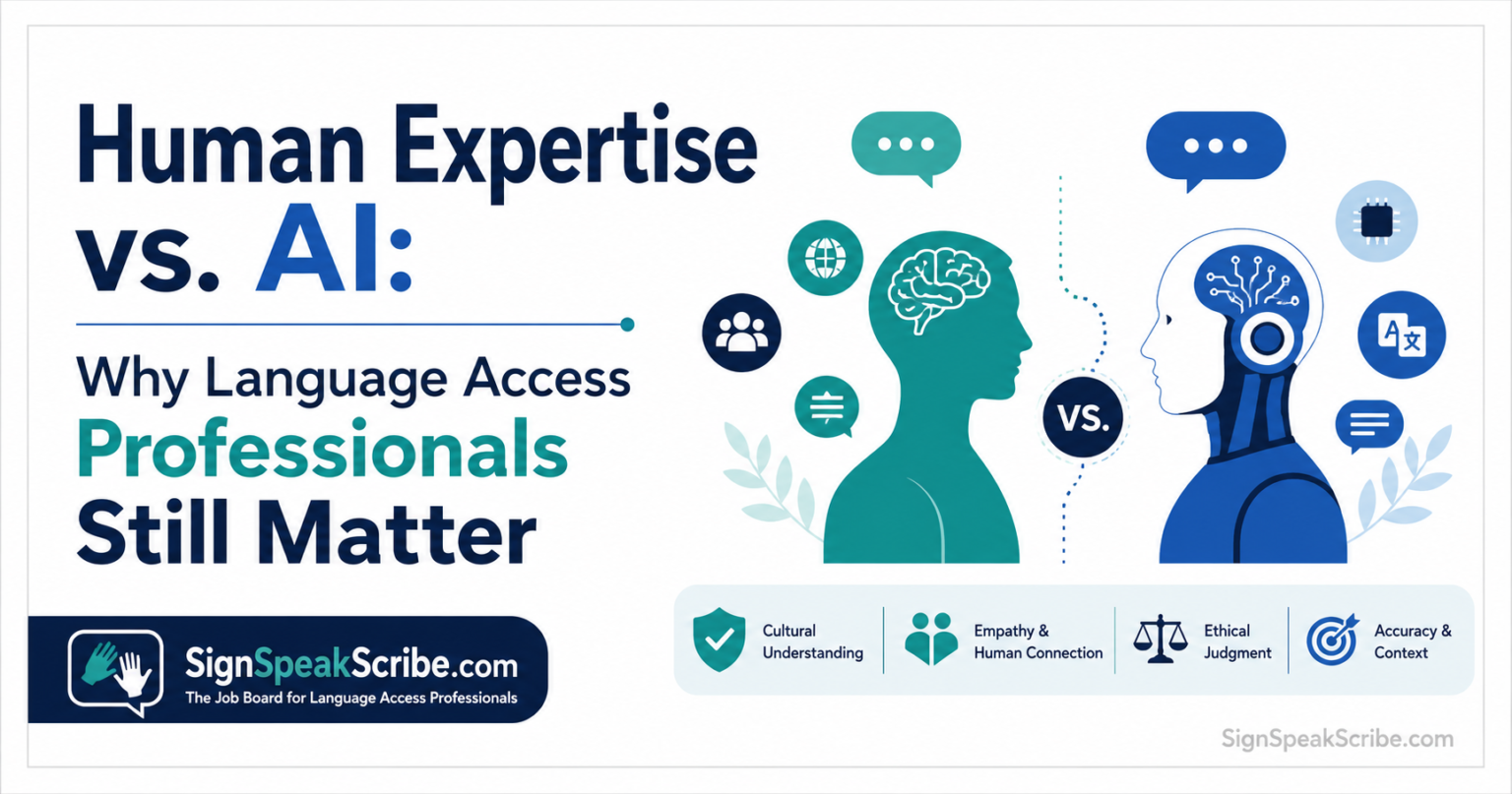
- Critical thinking
- Cultural understanding
- Ethical decision-making
- Empathy
- Trust
- Accuracy
- Professional accountability
Organizations that combine both technologies and human expertise will deliver the highest quality language access services.
Key Takeaways
- AI is transforming language access but cannot replace human expertise.
- Language access professionals provide cultural understanding, ethical judgment, and contextual accuracy.
- Human interpreters, translators, captioners, transcriptionists, and audio description specialists continue to play essential roles.
- AI works best as a productivity tool rather than a complete replacement.
- Employers increasingly value professionals who can effectively combine human expertise with modern AI technologies.
Frequently Asked Questions
Will AI replace interpreters?
AI can assist interpreters with certain tasks, but it cannot replace the cultural understanding, ethical judgment, and real-time decision-making that professional interpreters provide.
Can AI produce accurate translations?
AI performs well for straightforward content but may struggle with complex terminology, cultural nuances, humor, idioms, and context-sensitive communication.
Is AI useful for language access professionals?
Yes. Many professionals use AI to improve efficiency through transcription, terminology research, workflow automation, and drafting translations while maintaining human review and quality control.
Which language access careers are least likely to be replaced by AI?
Roles requiring high levels of human judgment—including sign language interpreters, medical interpreters, legal interpreters, conference interpreters, CART captioners, and audio description specialists—are expected to remain in strong demand.
Conclusion
Artificial intelligence is reshaping the language access industry, but technology alone cannot replace human communication. The most effective language access solutions combine the efficiency of AI with the expertise of trained professionals who understand language, culture, ethics, and human connection.
As AI continues to evolve, the value of experienced language access professionals will remain clear. Organizations that invest in both innovative technology and skilled human experts will provide more accurate, accessible, and inclusive communication for everyone.
Call to Action
Whether you’re an interpreter, translator, captioner, transcriptionist, audio description specialist, or another language access professional, your expertise continues to matter. Explore career opportunities, discover industry resources, and stay informed about the future of language access by visiting SignSpeakScribe.com—your job board for language access professionals.