Introduction
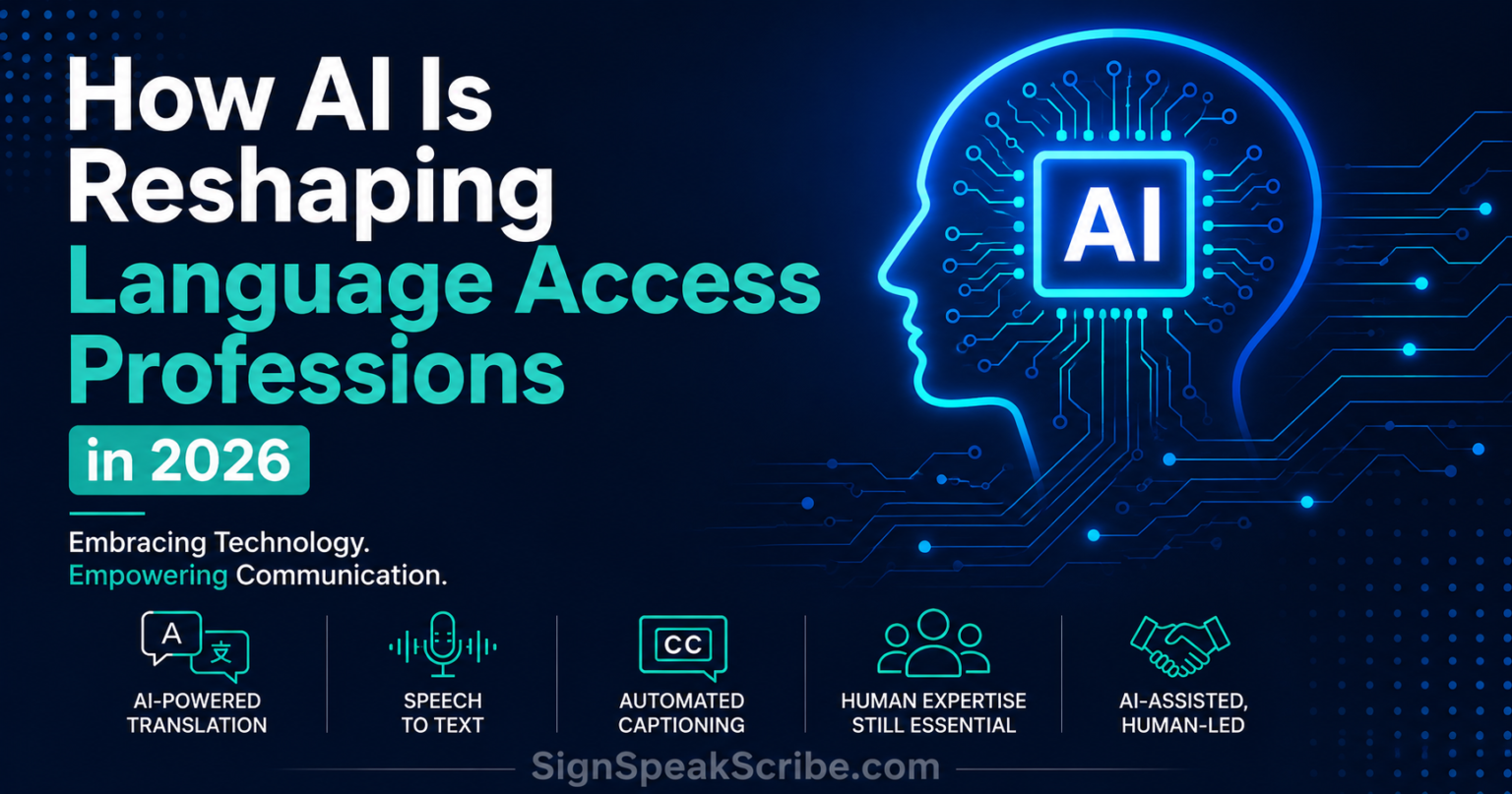
Artificial intelligence (AI) is transforming nearly every industry, and language access is no exception. From automated captioning to real-time translation tools, AI technologies are becoming more powerful and widely available than ever before.
For language access professionals—including sign language interpreters, spoken language interpreters, translators, captioners, transcribers, and accessibility specialists—the rise of AI brings both opportunities and challenges. While some routine tasks are becoming automated, the need for qualified professionals remains strong in areas where accuracy, cultural understanding, and human judgment are critical.
As we move through 2026, understanding how AI fits into the language access landscape is becoming increasingly important for both professionals and employers.
What AI Can Do Well
AI has made significant advances in communication and accessibility services. Several tasks that once required extensive human effort can now be completed quickly and efficiently by technology.
Machine Translation
AI-powered translation tools can instantly convert text between multiple languages. These systems have improved dramatically in recent years and are often useful for basic communication, website content, and internal documents.
For organizations needing fast translations, AI can provide a helpful starting point and reduce turnaround times.
Speech-to-Text
Automatic speech recognition technology has become highly effective at converting spoken language into written text. Many meetings, webinars, and presentations now use AI-generated transcripts as a standard feature.
This technology helps improve accessibility while reducing the manual effort required for basic transcription.
Automated Captioning
Live and recorded video content increasingly relies on AI-generated captions. Platforms such as video conferencing tools and streaming services now offer automatic captioning capabilities that can provide immediate accessibility support.
Meeting Summaries
AI can also generate meeting notes, summaries, and action items from recorded conversations. This helps organizations save time and improve productivity while keeping teams informed.
While these tools offer substantial benefits, they are not perfect—and that’s where human expertise becomes essential.
Where Human Professionals Remain Essential
Despite rapid advancements, AI still struggles with many aspects of communication that require context, judgment, and cultural understanding.
Sign Language Interpreting
Sign languages are complete visual languages with their own grammar, syntax, and cultural elements. AI technologies have made progress in recognizing signs, but they remain far from matching the skill of professional interpreters.
Human interpreters can adapt to regional variations, individual communication preferences, and complex interactions that AI systems often miss.
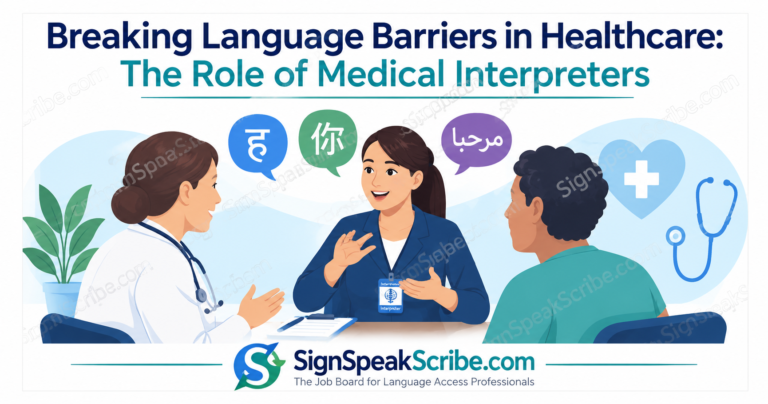
Medical Interpreting
Healthcare environments require precise communication. A misunderstanding involving symptoms, diagnoses, treatment options, or medication instructions can have serious consequences.
Professional medical interpreters provide accuracy, confidentiality, and the ability to navigate emotionally sensitive situations—areas where AI remains limited.
Legal Interpreting
Legal proceedings demand exact communication. Courtrooms, depositions, and attorney-client meetings often involve complex terminology and high-stakes decisions.
Errors in interpretation can significantly affect legal outcomes, making qualified human interpreters indispensable.
Cultural Nuance
Language is more than words. Tone, context, cultural references, idioms, humor, and social expectations all influence meaning.
Human professionals understand these nuances and can adjust communication accordingly, helping ensure messages are interpreted as intended.
High-Stakes Communication
Whenever accuracy, safety, compliance, or human relationships are involved, professional language access providers continue to play a critical role.
AI may assist the process, but responsibility for quality often remains with trained professionals.
Opportunities Created by AI
Rather than eliminating jobs, AI is creating new opportunities for language access professionals willing to adapt and expand their skill sets.
Post-Editing Machine Translations
Many organizations now use AI-generated translations as a first draft. Human translators review, correct, and refine the content to ensure accuracy and readability.
This growing specialty combines efficiency with professional expertise.
Caption Quality Review
As automated captioning becomes more common, there is increasing demand for professionals who can review captions, correct errors, and ensure accessibility standards are met.
Accessibility Consulting
Organizations are seeking guidance on how to implement AI tools responsibly while maintaining accessibility compliance.
Language access professionals who understand both accessibility requirements and emerging technologies can provide valuable consulting services.
AI Workflow Management
Businesses need professionals who can oversee AI-assisted workflows, evaluate quality, and determine when human intervention is necessary.
This creates opportunities for experienced professionals to move into supervisory and quality management roles.
Skills Language Access Professionals Should Develop
The future of language access will likely involve collaboration between humans and technology. Professionals who embrace this reality can position themselves for long-term success.
Technology Literacy
Understanding how AI tools work—and where they fail—can help professionals make informed decisions and improve service delivery.
Quality Assurance
As AI-generated content becomes more common, quality control skills will become increasingly valuable.
Professionals who can identify errors, verify accuracy, and maintain standards will remain in demand.
Accessibility Expertise
Accessibility regulations and best practices continue to evolve. Professionals who understand compliance requirements and user needs will have a competitive advantage.
Specialized Subject-Matter Knowledge
Deep expertise in fields such as healthcare, law, education, government, or technical industries can make professionals significantly more valuable than generalized AI systems.
Specialization often provides protection against automation while increasing earning potential.
What Employers Should Know
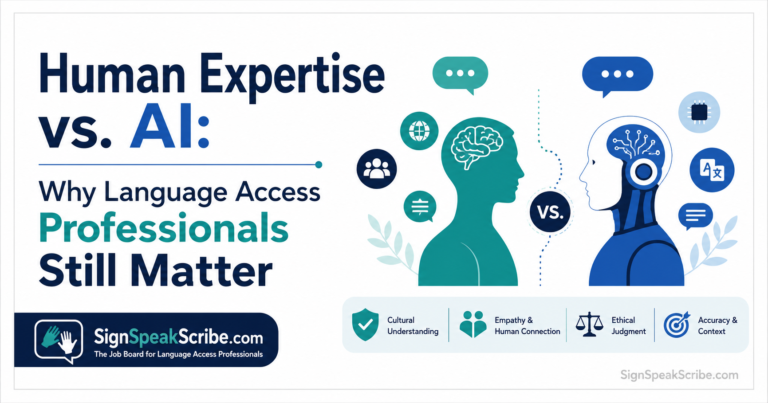
Organizations should view AI as a tool—not a complete replacement for qualified language access professionals.
While AI can improve efficiency and reduce costs in certain situations, relying exclusively on automated systems may introduce risks related to accuracy, compliance, confidentiality, and user experience.
Employers should carefully evaluate:
- The complexity of the communication.
- The potential consequences of errors.
- Accessibility requirements.
- Legal and regulatory obligations.
- The need for cultural competence.
For many situations, the most effective approach is a combination of AI-powered tools and qualified human professionals.
Key Takeaways
- AI is transforming language access services in 2026.
- Machine translation, speech-to-text, captioning, and meeting summaries continue to improve.
- Human professionals remain essential for sign language, medical, legal, and high-stakes communication.
- New career opportunities are emerging in AI-assisted workflows, quality assurance, and accessibility consulting.
- Professionals who develop technology and specialization skills will be well-positioned for future growth.
- Employers should view AI as a support tool rather than a complete replacement for qualified language access providers.
Frequently Asked Questions
Will AI replace interpreters and translators?
AI is unlikely to fully replace qualified language professionals, particularly in high-stakes environments where accuracy, cultural understanding, and human judgment are essential.
What language access jobs are most affected by AI?
Routine translation, transcription, and captioning tasks are experiencing the greatest automation. However, quality review and oversight roles are growing.
What skills should language professionals learn in 2026?
Technology literacy, quality assurance, accessibility expertise, and specialized industry knowledge are among the most valuable skills to develop.
Is AI useful for accessibility?
Yes. AI can improve accessibility through automated captions, speech recognition, and translation tools. However, human oversight is often necessary to ensure quality and accuracy.
Conclusion
The future of language access is not a choice between humans and AI—it is a partnership between the two.
AI is helping organizations communicate faster and more efficiently, while human professionals continue to provide the expertise, judgment, and cultural understanding that technology cannot fully replicate.
For language access professionals, the opportunity lies in adapting to new tools, expanding specialized skills, and positioning themselves as experts who can bridge the gap between technology and human communication.
The future of language access is increasingly AI-assisted—but it remains fundamentally human-led.
Call to Action
Are you a language access professional looking for new opportunities in interpreting, translation, captioning, transcription, or accessibility services?
Visit SignSpeakScribe.com to explore job opportunities, connect with employers, and stay informed about the latest trends shaping the language access industry.