Emerging Technologies in Captioning and Audio Description
Technology is changing the way people create, deliver, and experience accessible media. Emerging technologies in captioning and audio description are making it possible to produce accessibility features more efficiently while opening new possibilities for language access professionals.
From artificial intelligence and automatic speech recognition to synthetic voices and increasingly sophisticated media platforms, technology is becoming an important part of the accessibility workflow. At the same time, technology does not eliminate the need for human expertise. Accuracy, context, timing, cultural understanding, and quality control remain essential.
As video continues to dominate entertainment, education, business communications, social media, and online learning, the future of accessible media will likely involve a combination of technology and human professionals.
1. Artificial Intelligence and Automated Captioning
One of the most visible developments is the growth of AI captioning technology.
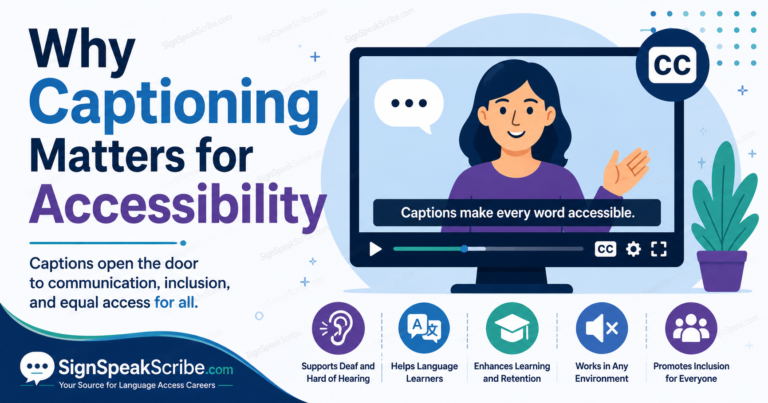
Automated captioning systems use speech recognition and machine-learning technologies to convert spoken language into text. These systems can process large amounts of audio and video considerably faster than traditional manual workflows.
For organizations producing webinars, training videos, meetings, online courses, or social media content, automated captioning can provide a starting point for creating captions.
However, automated captions are not automatically accurate captions.
Background noise, multiple speakers, accents, specialized terminology, names, overlapping conversations, and poor-quality audio can all affect recognition. Even a small transcription error can change the meaning of a statement.
That is why human review remains important. Captioning professionals can correct errors, identify speakers, improve punctuation and readability, synchronize captions with speech, and make sure important non-speech information is communicated appropriately.
The likely future is not simply “AI versus captioners.” Instead, AI may increasingly become one tool within a professional captioning workflow.
2. Real-Time Captioning Is Becoming More Accessible
Another important development is the expansion of real-time captioning.
Speech recognition technology can now generate captions during meetings, livestreams, online classes, conferences, and other live events. This can make information more accessible without requiring captions to be created entirely after an event has ended.
Real-time captioning can be particularly useful when information needs to be available immediately.
However, live environments create additional challenges. Speakers may talk over one another, microphones may produce inconsistent audio, people may use industry-specific terminology, and there may be little opportunity to correct mistakes before viewers see them.
For high-stakes settings such as healthcare, legal proceedings, education, government meetings, and major public events, accuracy and reliability remain particularly important.
Technology can help increase speed and availability, while trained professionals can provide the expertise needed to monitor quality and address problems.
3. AI and the Future of Audio Description
Captioning primarily addresses information delivered through sound. Audio description, on the other hand, provides spoken information about important visual elements for people who are blind or have low vision.
According to the W3C, audio description can communicate information such as actions, characters, scene changes, and on-screen text that may not otherwise be available through the main soundtrack.
Emerging AI systems are beginning to create new possibilities for AI audio description.
Computer vision and multimodal AI can analyze visual content and identify objects, scenes, actions, text, and other elements. In the future, these technologies could assist with identifying the visual information that should be considered for description.
For example, an AI system could analyze a video and identify that a person enters a room, a presentation slide changes, or important text appears on screen. A human audio describer could then review that information and determine what should actually be included in the final description.
This distinction is important.
Audio description is not simply a matter of describing everything visible on the screen. The goal is to communicate the visual information that is important to understanding the content, while working within available pauses in dialogue and other audio.
4. Synthetic Voices and Personalized Audio Experiences
Text-to-speech and synthetic voice technology are also developing rapidly.
For audio description, synthetic voices could potentially allow organizations to create narrated accessibility tracks more quickly or produce multiple language versions of accessible content.
This could be particularly useful for large libraries of educational, corporate, or informational videos.
But voice quality is only one consideration.
An effective audio description track must communicate the right information at the right moment. The narration must fit naturally with dialogue, music, sound effects, and other important audio.
W3C guidance emphasizes that audio description is synchronized with the media and normally uses available pauses so that the additional narration does not obscure important dialogue or sound.
As synthetic voices improve, accessibility professionals may increasingly focus less on simply producing a voice track and more on reviewing the content, timing, language, and overall user experience.
5. Smarter Media Players and Personalized Accessibility
The future of accessibility technology is also moving beyond simply creating captions and descriptions.
Modern media players can provide users with greater control over accessibility features. Users may be able to turn captions or audio description on and off, select languages, adjust presentation preferences, or choose alternative audio tracks.
W3C documentation describes user-selectable audio-description tracks as one way to provide accessible video experiences.
This creates an opportunity for more personalized media experiences.
Instead of assuming that every viewer needs the same accessibility features, platforms can allow individuals to choose the tools that work best for them.
That approach aligns with a broader principle of accessibility: give people meaningful choices whenever possible.
6. Translation and Multilingual Accessibility
Another emerging area is the combination of captioning, translation, and artificial intelligence.
An original caption file can potentially serve as the foundation for creating captions in additional languages. AI-powered translation systems can accelerate this process and make multilingual content more accessible to audiences around the world.
However, automated translation can introduce its own problems. Idioms, technical terminology, cultural references, names, and context can be difficult for automated systems to interpret correctly.
Human language professionals therefore continue to have an important role in reviewing translated captions and accessibility content.
For organizations working across multiple languages, the combination of automation and professional review may provide a way to expand accessibility while maintaining quality.
7. What These Technologies Mean for Accessibility Professionals
The growth of technology does not necessarily mean fewer opportunities for captioners, audio describers, and other accessibility professionals.
Instead, the nature of the work may continue to evolve.
Professionals may increasingly work with AI-assisted tools rather than performing every step manually. Their responsibilities could include editing automated captions, quality assurance, terminology management, accessibility review, script development, audio-description editing, and evaluating whether automated output actually communicates the intended information.
Human judgment is especially important when accessibility depends on context.
A computer can recognize words. It can identify objects. It can generate text. It can produce synthetic speech.
But accessibility often requires determining what matters to the person consuming the content.
That is where professional expertise remains valuable.
Key Takeaways
- AI and automated captioning can speed up the creation of captions and transcripts.
- Real-time speech recognition is expanding access to live content.
- AI and computer vision may assist with identifying visual information for audio description.
- Synthetic voices could make audio-description production more scalable.
- Modern media players can provide users with greater control over accessibility features.
- AI-powered translation can help expand multilingual accessibility.
- Human professionals remain important for accuracy, context, quality assurance, and accessibility judgment.
- The future is likely to involve technology working alongside captioners, audio describers, translators, and other accessibility professionals.
Frequently Asked Questions
Will AI replace captioners?
AI can automate portions of the captioning workflow, but automated output can contain errors involving speech recognition, punctuation, speakers, terminology, and context. Human review remains important when accuracy and accessibility are critical.
Can AI create audio descriptions?
AI technologies can analyze visual information and generate descriptions, but creating effective audio description involves more than identifying objects or actions. Timing, relevance, context, and synchronization are also important.
What is the difference between captions and audio description?
Captions provide a text representation of spoken dialogue and relevant audio information. Audio description provides spoken information about important visual information that may not be communicated through the existing soundtrack.
Will technology create new jobs in accessibility?
Technology is changing accessibility workflows and may create new roles involving AI-assisted captioning, quality assurance, accessibility testing, content review, and technology management. The specific impact will vary by industry and application.
Conclusion
The future of captioning and audio description is becoming increasingly connected to artificial intelligence, speech recognition, computer vision, synthetic voices, and smarter media platforms.
These technologies can help make accessible content faster and more scalable. But accessibility is ultimately about more than producing text or audio automatically. It is about making sure people receive the information they need in a way that is accurate, understandable, timely, and usable.
As technology continues to develop, captioners, audio describers, translators, accessibility specialists, and other language access professionals will have opportunities to work alongside these tools and help shape how they are used.
The most important question may not be whether technology can create accessibility content.
It may be how technology and human expertise can work together to create better accessibility for everyone.
Make Accessibility Part of Your Career
Whether you work in captioning, transcription, audio description, interpreting, translation, or another area of language access, staying informed about emerging technology can help you understand where the industry is heading.
Visit SignSpeakScribe.com to explore language access career opportunities and resources for professionals across the industry.