


Introduction
The demand for language access professionals continues to grow across healthcare, education, government, legal services, business, and media industries. However, competition for top opportunities is also increasing. Understanding what employers look for when hiring language access professionals can help candidates position themselves more effectively and improve their chances of securing interviews and job offers.
Whether you are an interpreter, translator, captioner, transcriptionist, audio descriptionist, or another language access specialist, employers generally evaluate candidates across several common areas beyond simply knowing two languages.
1. Relevant Certifications and Credentials
For many employers, certifications and credentials are the first indicators of professional competence.
Requirements vary depending on the profession and industry:
- Sign language interpreters may be expected to hold national or state certifications.
- Spoken language interpreters often need medical, legal, or court interpreting credentials.
- Translators may benefit from professional translation certifications.
- Captioners and CART providers may require specialized training or certifications.
- Audio description professionals often demonstrate competency through portfolios and specialized education.
While not every role requires certification, employers frequently view credentials as evidence of professionalism, commitment, and industry standards compliance.
What employers want to see:
- Current certifications and/or licenses
- Continuing education participation
- Specialized industry training
- Compliance with local regulations or credentialing requirements
2. Industry-Specific Experience
Many employers prioritize experience within their specific industry over general experience.
For example:
- Hospitals prefer professionals familiar with medical terminology and patient interactions.
- Law firms and courts seek candidates with legal terminology expertise.
- Educational institutions often prefer experience working with students and educators.
- Corporate clients value familiarity with business terminology and meeting environments.
A candidate with three years of healthcare interpreting experience may be more competitive for a hospital position than someone with ten years of unrelated interpreting experience.
Ways to demonstrate industry experience:
- Include relevant assignments on your resume.
- Highlight specialized terminology knowledge.
- Showcase case studies or project examples.
- Maintain portfolios when appropriate.
3. Strong Communication Skills
Technical skills are essential, but employers consistently rank communication skills among the most important hiring factors.
Language access professionals frequently work in high-pressure environments where accuracy and professionalism directly impact outcomes.
Employers value candidates who can:
- Communicate clearly and professionally.
- Adapt communication styles to different audiences.
- Remain calm under pressure.
- Manage difficult conversations effectively.
- Maintain neutrality and professionalism.
For interpreters especially, employers often evaluate both linguistic ability and interpersonal communication skills during interviews or assessments.
4. Cultural Competency
Language access involves much more than word-for-word translation.
Employers increasingly seek professionals who understand cultural nuances and can navigate differences respectfully and effectively.
Cultural competency helps professionals:
- Avoid misunderstandings.
- Improve communication outcomes.
- Build trust between parties.
- Support inclusive environments.
Organizations serving diverse populations often consider cultural awareness a major competitive advantage.
5. Technology Proficiency
Technology is becoming increasingly important across the language access industry.
Today’s professionals are often expected to work with:
- Video Remote Interpreting (VRI) platforms
- Remote meeting software
- Captioning software
- Translation management systems
- AI-assisted translation tools
- Scheduling and workflow platforms
Remote and hybrid work environments have made technical proficiency an essential hiring factor rather than a bonus skill.
Candidates who embrace technology often stand out during the hiring process.
6. Reliability and Professionalism
Many language access assignments involve sensitive information, time-critical communication, or legal obligations.
As a result, employers place enormous value on professionalism and dependability.
Employers want professionals who:
- Arrive on time.
- Meet deadlines consistently.
- Respond promptly to communication.
- Maintain confidentiality.
- Follow professional codes of ethics.
A highly skilled professional who is unreliable may be less desirable than a slightly less experienced candidate with a strong reputation for dependability.
7. Flexibility and Adaptability
The language access field can be unpredictable.
Assignments may involve:
- Different subject matters
- Changing schedules
- Remote and in-person settings
- Diverse client populations
- Rapidly evolving technologies
Employers appreciate candidates who can adapt quickly while maintaining service quality.
Flexibility often becomes particularly important for freelance professionals and independent contractors.
8. Commitment to Continuing Education
The language access industry continues to evolve through technology, regulations, accessibility standards, and emerging best practices.
Employers value candidates who actively invest in professional development.
Examples include:
- Attending conferences and workshops
- Participating in webinars
- Maintaining certifications
- Learning new technologies
- Expanding into specialized subject areas
Demonstrating a growth mindset signals long-term value to employers.
Key Takeaways
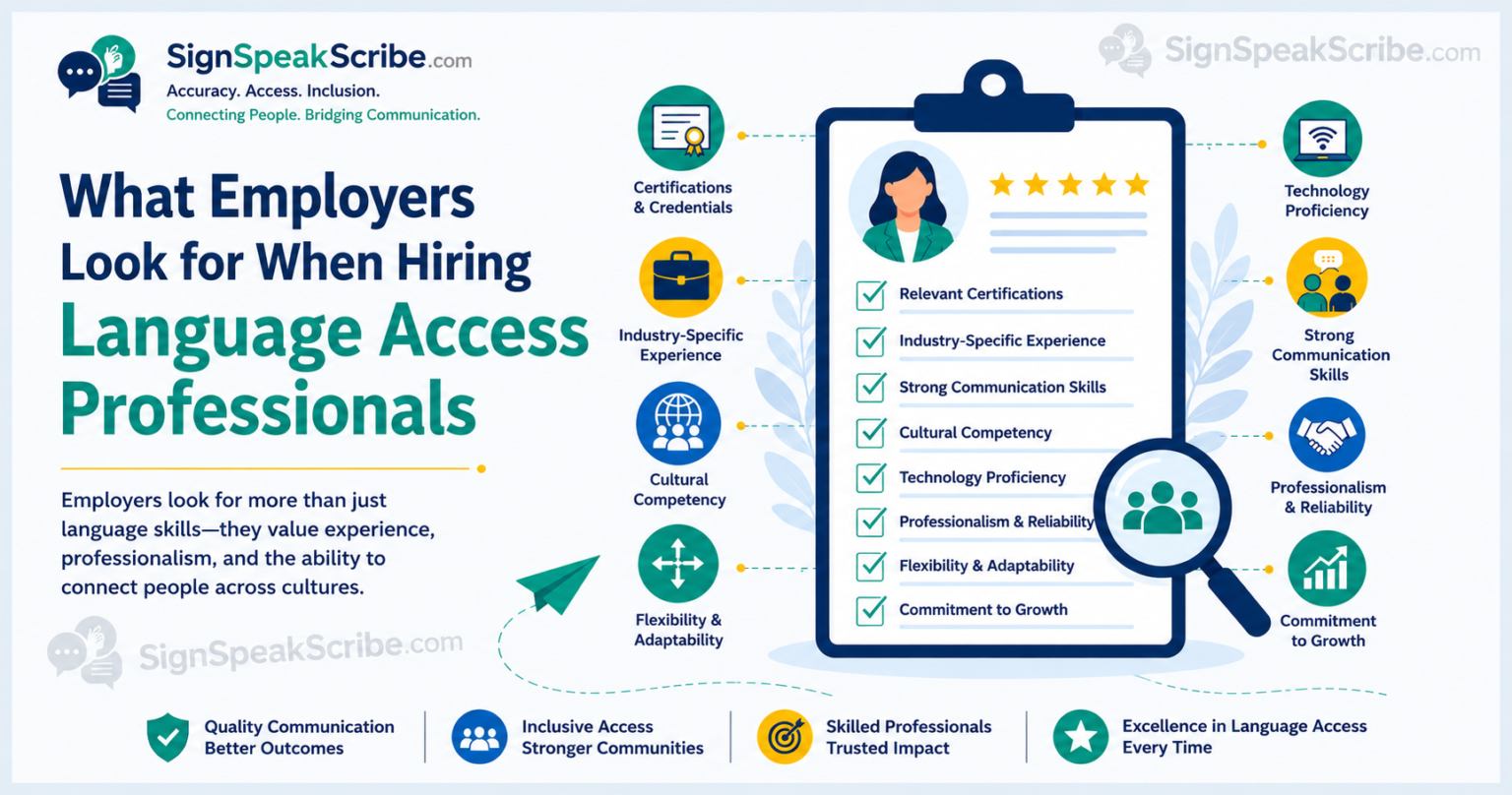
When hiring language access professionals, employers typically prioritize:
✓ Relevant certifications and credentials
✓ Industry-specific experience
✓ Strong communication skills
✓ Cultural competency
✓ Technology proficiency
✓ Reliability and professionalism
✓ Flexibility and adaptability
✓ Commitment to continuing education
Candidates who can demonstrate strength across these areas are often more competitive in today’s hiring market.
Frequently Asked Questions
Do employers require certifications for all language access jobs?
No. Requirements vary by profession, industry, and location. However, certifications often improve competitiveness and earning potential.
Is experience more important than certification?
In many cases, employers prefer candidates who possess both. Industry-specific experience can sometimes outweigh certification requirements depending on the role.
Are remote work skills important for language access professionals?
Yes. Remote interpreting, captioning, translation, and transcription services continue to expand, making technology skills increasingly valuable.
What soft skills matter most?
Communication, professionalism, adaptability, cultural competency, and reliability consistently rank among the most important soft skills.
Conclusion
The most successful language access professionals combine technical expertise with professionalism, communication skills, and industry knowledge. Employers are increasingly looking beyond language fluency alone and evaluating candidates based on their ability to deliver accurate, culturally responsive, and technology-enabled services.
Understanding these expectations allows professionals to strengthen their resumes, improve interview performance, and position themselves for long-term career growth within the language access industry.
Call to Action
Looking for your next opportunity in the language access field?
Explore jobs for interpreters, translators, captioners, transcriptionists, audio descriptionists, and other professionals at SignSpeakScribe.com — the job board built specifically for the language access community.